
Advertising Disclosure: This site may receive compensation for service connections made through this page. Content is editorially independent.
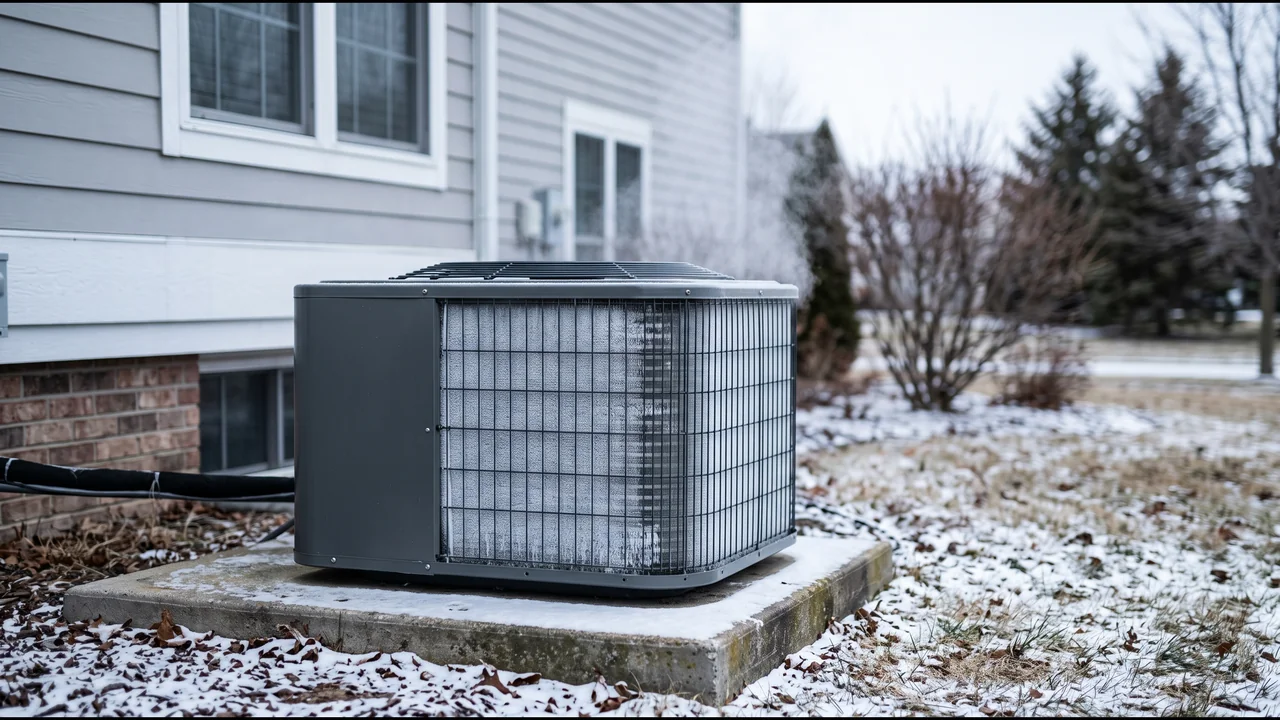
Some ice is normal. The pattern tells you which kind you have. A thin, even frost across the coil (Carrier's line is under about ¼ inch) that disappears on the next defrost is normal winter operation. So are a cloud of steam, a whooshing sound, and the outdoor fan stopping for a few minutes: that is the defrost cycle itself. Ice capped on the top or one side usually means water is dripping on the unit from the roof, which is a placement fix. A solid block of ice, ice that never clears, or ice that comes straight back after thawing means something has failed, and a technician needs to find out what. Never chip the ice or pour hot water on it.
You look out on a cold morning and the heat pump is white. Maybe it is steaming. Maybe the fan has stopped and it is making a noise you have not heard before. The question in your head is simple: is this thing broken?
Usually not. A heat pump in heating mode pulls heat out of the outdoor air, which makes the outdoor coil colder than the air around it, so moisture freezes on it. Heat pumps have an automatic defrost cycle to melt it off. Our cold-weather physics explainer covers why the coil gets that cold; this article is the part you need standing at the window: how to tell normal frost from ice that means trouble, what to do (and not do) in the meantime, and what to say when you call.
What a Normal Defrost Cycle Looks and Sounds Like
When enough frost builds up, the heat pump switches into defrost. Trane describes it plainly: the reversing valve flips the refrigerant flow to heat up the outdoor coil, which puts the system into cooling mode for a few minutes. While that happens, Trane, Lennox and American Standard all list the same normal signs:
- A cloud of steam rising off the unit. That is melting frost evaporating, not smoke.
- A whooshing or swooshing sound as the refrigerant changes direction.
- The outdoor fan stops while the compressor keeps running, and the compressor may get louder or quieter.
- Water running off the coil as the frost melts.
How long it lasts depends on the equipment. Trane says its sensor-driven "demand defrost" usually takes 3 to 5 minutes; Carrier puts a typical cycle at about 5 to 10 minutes; Lennox says 5 to 15. Lennox also says the system checks for frost every 30 to 90 minutes in heating mode, and that on damp days frost builds faster, so you will see more defrost cycles than on dry ones.
Inside, you may notice nothing at all. Lennox and Trane both note that many heat pumps bring on backup heat during defrost so the house doesn't cool down. Without backup heat, Trane says, the vents can blow cool air for those few minutes, and that is still normal.
The Four Ice Patterns and What Each One Means
The whole diagnosis comes down to two observations: where the ice is, and whether it clears on the next defrost. Watch the unit for an hour or two. If it defrosts and the coil comes out clean, you are fine.
| What you see | What it usually means | What to do |
|---|---|---|
| Thin, even white frost across the coil; clears after a defrost | Normal heating-mode operation (Carrier: frost generally under ¼ inch that clears on defrost) | Nothing. Keep snow and leaves away from the unit. |
| Steam, whooshing, fan stopped for a few minutes | A defrost cycle in progress | Nothing. Check again after it ends. |
| Ice capped on the top or one side; rest of the coil clear | Water from the roof or a gutter falling on the unit and refreezing | Book a non-urgent visit to fix placement or add a drip shield. |
| Solid ice over the coil or fan; ice that never clears or returns right after thawing | A failure: defrost controls, airflow, refrigerant charge, or the outdoor fan | Call a technician. Do not try to remove the ice. |
Normal and abnormal thresholds from Carrier and Lennox; causes of heavy ice from Lennox and Carrier.
Pattern 1: Light frost that comes and goes
This is the heat pump doing its job. Carrier's line is a thin layer, generally less than ¼ inch, that clears during the automatic defrost. If you check back after a defrost and the fins are dark and wet again, nothing is wrong.
Pattern 2: Steam and a stopped fan
This is the cycle that clears pattern 1. The one thing that turns it into a problem is frequency or length: Trane says to call if the unit seems to be constantly switching into defrost, or if defrost cycles keep getting longer while ice spreads over the unit. Lennox says cycles that repeatedly run past 15 minutes need a professional look.
Pattern 3: Ice on top or one side
If the ice is thickest on the lid or one face, and it looks like it grew from dripping water, look up. Carrier lists water from melting snow or ice leaking onto the coil as a cause of a frozen heat pump. DOE's Building America Solution Center shows exactly this: a unit that sat on a stand but was still encased in ice by water dripping from the roof above it. The heat pump itself may be healthy. The fix is placement. NEEP's cold-climate installation guide says outdoor units should not sit under a roof drip line, and where that can't be avoided and there is no working gutter, they should get a drip cap or shield approved by the manufacturer. A clogged or leaking gutter over the unit is worth fixing first.
Pattern 4: A block of ice that won't clear
Solid ice across the coil, ice on the fan blades, or ice that comes back right after it melts means the defrost isn't keeping up. Lennox says heavy ice that covers the unit or blocks airflow signals a problem, and that ice which refreezes quickly after thawing points to refrigerant leaks or control failures. This is the pattern that needs a technician.
Get connected with a technician in your ZIP code before the ice spreads.
Call Now — (844) 582-1795Disclosure: We are a referral service and may receive compensation for qualified calls. Calls may be routed to an independent provider network and may be recorded. Pricing and availability vary by provider and location.
Why You Shouldn't Wait Out Heavy Ice
A heat pump heats your home by pulling heat from outdoor air across that coil. When ice seals the coil or locks the fan, air can't get through, which is why Lennox treats ice that blocks airflow as a problem rather than a nuisance. The causes Lennox and Carrier list for heavy ice are not ones that fix themselves: a failed defrost control or sensor, low refrigerant from a leak, a failed outdoor fan motor, or a reversing valve that isn't switching. Waiting for a warmer day may melt the ice, but the cause is still there on the next cold night.
There is also a safety side outside the house. NEEP warns installers to keep units away from walkways because defrost meltwater refreezes. If your unit sits next to a path or steps, expect ice there on cold mornings.
What You Can Safely Do (and What to Leave Alone)
The list of safe homeowner steps is short on purpose. Everything else on a heat pump belongs to a technician.
- Check the air filter. Lennox lists dirty filters among the airflow restrictions behind heavy ice, and ENERGY STAR says to inspect or change the filter once a month. If it is gray and clogged, replace it.
- Move snow and leaves away from the unit. Clear drifted snow and leaves back from the sides and top, keeping your shovel or hands off the coil, fins, and fan. NEEP's installation guide calls for units to sit above the typical maximum snow depth, so a unit buried in a drift is starved of air.
- Leave the thermostat on its normal heat setting unless a technician tells you otherwise. The unit needs to run to defrost.
- Note what you see. Which pattern, how long it has lasted, and whether it cleared after a defrost. That is the most useful thing you can give the technician.
Do not chip, pry, or scrape the ice (Carrier: "Never try to chip ice from the coil"). Do not pour hot water on it; Lennox warns the sudden temperature change can crack components. Do not spray it with a hose, use a heat gun or hair dryer on it, open the cabinet, or switch the power off at the disconnect or the breaker yourself. The technician will handle power and access on arrival.
What the Technician Checks
A service call for an iced heat pump is a process of elimination through the causes Carrier and Lennox list. You can expect the technician to:
- Look at the ice pattern and the placement first: roof drip line, gutters, whether the unit sits high enough above snow and has somewhere for meltwater to drain.
- Check airflow: the indoor filter and blower, and the outdoor fan motor, which Carrier lists among the equipment failures that stop a unit from deicing.
- Test the defrost controls: the defrost control board and the coil sensor that tells it when to start and stop.
- Confirm the unit actually switches into defrost and heats the outdoor coil, which checks the reversing valve Lennox lists among the failed components behind heavy ice.
- Check the refrigerant charge if the controls check out. Low charge usually means a leak, and refrigerant work is restricted to EPA Section 608 certified technicians.
The diagnostic or service-call fee runs $65–$150 in our 2026 HVAC cost guide, with the repair billed separately. Our walkthrough of what an HVAC technician does on a service call covers what that fee pays for, and the heat pump repair guide covers the common heat pump repairs and where to find their price ranges.
What to Tell the Dispatcher, and What to Watch For
When you call, give the facts in this order: "My heat pump has [thin frost / ice on top / a solid block of ice] on the outdoor unit. It has been like that for [how long]. It [does / doesn't] clear after a defrost." Add the rough age of the system and the brand on the unit's label if you can read it from a distance, and whether the house is still holding temperature. That lets the technician arrive expecting a placement problem or a failed component instead of starting cold.
Two things to watch for on the visit. First, if the ice was pattern 3 (top or one side) and the answer offered is a whole new system, ask whether fixing the gutter, adding a manufacturer-approved drip shield, or raising the unit would solve it; NEEP treats those as standard installation practice. Second, if a technician says the refrigerant is low, ask whether they found and will repair the leak. Lennox ties low refrigerant to leaks, so topping it up without repairing the leak leaves the cause of the ice in place. If the system is older and the repair is large, our repair-or-replace framework walks through the decision.
How Your Climate Changes What You'll See
Defrost behavior tracks the weather, so the same heat pump looks different in different places. Climate zone and average winter lows below come from our city pages:
- Rapid City, SD (Zone 5B, average winter low 11°F): the coldest winter lows of these four. Check drifted snow and roof runoff first, and whether the unit sits above typical snow depth.
- Eugene, OR (Zone 4C, average winter low 35°F): damp winters near freezing. Lennox notes frost forms faster on damp days, so frequent short defrost cycles are expected; a coil that stays white is not.
- Charlotte, NC (Zone 3A, average winter low 32°F): an average winter low right at freezing, so light overnight frost and a defrost cycle soon after are normal to see.
- Shreveport, LA (Zone 3A, average winter low 37°F): the mildest winter lows of these four. Light frost can still form on cold nights, but a solid block of ice is pattern 4 and worth a call rather than a wait.
If you are still deciding what kind of heat pump suits a cold climate, the 2026 heat pump buyer's guide covers cold-climate models and what to ask before you buy.
Trusted Industry Sources
The frost thresholds, defrost behavior, causes, and placement guidance in this article come from:
- Carrier — Heat Pump Troubleshooting Guide
- Lennox — What to Do If Your Heat Pump Is Frozen
- Lennox — Understanding the Heat Pump Defrost Cycle
- Trane — What Is the Heat Pump Defrost Cycle?
- NEEP — Guide to Installing Air-Source Heat Pumps in Cold Climates (PDF)
- U.S. DOE Building America Solution Center — Protecting Outdoor HVAC Units
- ENERGY STAR — Maintenance Checklist
- EPA — Section 608 Technician Certification
Tell the dispatcher the ice pattern and how long it has lasted.
Call Now — (844) 582-1795Disclosure: We are a referral service and may receive compensation for qualified calls. Calls may be routed to an independent provider network and may be recorded. Pricing and availability vary by provider and location.
Frequently Asked Questions
A thin layer of frost is normal. Carrier describes frost generally less than 1/4 inch that clears during the automatic defrost cycle as normal winter operation. Ice thicker than that, a solid coating, or ice that does not clear during defrost is not normal and needs a technician.
It is almost always a defrost cycle. The heat pump briefly reverses to warm the outdoor coil, and the melting frost gives off a cloud of steam. Trane and Lennox both describe the steam, a whooshing sound as the refrigerant reverses, and a stopped outdoor fan as normal parts of defrost. It is not smoke and not a fire.
It depends on the system. Trane says its demand-defrost systems usually run 3 to 5 minutes, Carrier puts a typical cycle at about 5 to 10 minutes, and Lennox says 5 to 15 minutes. Lennox says cycles that repeatedly run past 15 minutes warrant a professional inspection.
No. Lennox warns never to pour hot water on the unit because the sudden temperature change can crack components, and Carrier says never to chip ice from the coil. Leave the ice alone, make sure snow and debris are not piled against the unit, and call a technician if the ice does not clear on the next defrost.
Ice on the top or one side, with the rest of the coil clear, usually means water is falling on the unit from the roof or a gutter and refreezing. Carrier lists water from melting snow or ice leaking onto the coil as a cause of freezing. NEEP's cold-climate installation guide says outdoor units should not sit under a roof drip line, and should get a manufacturer-approved drip cap or shield when that can't be avoided. It is a placement fix, not a sign the heat pump is failing.
Local HVAC Service Areas
Cool Call Pro connects homeowners with independent HVAC technicians nationwide. Find a pro in Eugene (OR), Shreveport (LA), Charlotte (NC), or Rapid City (SD), or browse by state: Oregon, Louisiana, or all locations.