
Advertising Disclosure: This site may receive compensation for service connections made through this page. Content is editorially independent.
The "one ton per 500 square feet" rule that many HVAC contractors use to size heat pumps is wrong. It ignores climate, insulation, window types, infiltration rate, orientation, occupancy, and internal loads -- every input that actually drives the home's heating and cooling load except square footage. The correct methodology is an ACCA Manual J residential load calculation, which produces a specific BTU-per-hour number for heating and cooling design conditions; equipment is then selected to match that load through ACCA Manual S. Oversizing has three specific costs: short-cycling that wastes energy and shortens equipment life; failed humidity removal that produces clammy indoor air in cooling season; and higher install + operating cost without proportional comfort benefit. Undersizing has one specific cost: excessive reliance on backup heat (electric resistance strips or a dual-fuel gas furnace) during peak weather. Oversizing is the more common error because oversized units don't produce homeowner complaints -- but the costs accumulate quietly across the equipment's lifetime. The homeowner verification workflow is three asks: request the Manual J PDF, sanity-check the input assumptions against your actual home, and compare the recommended equipment tonnage against the calculated BTU load.
You are evaluating a heat pump quote. The contractor recommended a 3-ton unit for a 1,800-square-foot home and the price is $12,000 to $16,000 installed per our 2026 HVAC cost guide. The recommendation seems reasonable -- 1,800 divided by 500 is roughly 3 tons, after all. But the same 1,800-square-foot home in coastal Eugene, Oregon and in mountain Reno, Nevada has dramatically different heating and cooling loads despite identical floor area. One is a coastal climate with mild winters; the other is high-elevation cold with sub-freezing winter nights. A sizing rule that ignores climate is a rule that ignores the actual problem being solved.
This article is the methodology framework for sizing a residential heat pump correctly, and the homeowner-verification workflow for spotting when a quote got it wrong. The C3 pillar (the 2026 heat pump buyer's guide) covers selection criteria once the right size is known. The cold-weather physics explainer (heat pumps in cold weather) covers what happens to capacity as outdoor temperature drops. The switch-decision article (should I switch from gas to heat pump) covers when a heat pump is the right call at all. This article's unique territory is the sizing question itself -- what determines the right tonnage, how to verify a contractor's number, and the costs of getting it wrong in either direction.
Why "One Ton Per 500 Square Feet" Is Wrong
The tonnage-per-square-foot rule of thumb originated as a rough estimating shortcut. Its persistence in the contractor industry is not because it produces accurate sizing; it persists because a Manual J load calculation takes 30 to 60 minutes to do correctly and the rule of thumb takes 10 seconds. Homeowners pay for the shortcut at install (when the wrong equipment is delivered) and across operating life (when the wrong equipment cycles inefficiently).
The rule ignores seven inputs that actually drive heating and cooling load: climate (outdoor design temperatures vary from 5°F in cold markets to 25°F+ in warm ones); insulation R-values (R-19 vs R-49 attic produces very different heat loss at the same square footage); window type, area, and orientation (single-pane south-facing glass is nothing like triple-pane low-E); infiltration rate (a tight newer home has 30-50% lower air leakage than an older leaky one); occupancy and internal heat loads (people, lighting, cooking, electronics); ceiling height (a 9-foot ceiling has 12.5% more conditioned volume than an 8-foot ceiling at identical floor area); and story count and layout (heat rises, so multistory homes distribute load differently).
Some homes happen to match the rule's implicit assumptions (new mixed-humid construction, average insulation, average occupancy) and it produces something close to the Manual J answer. Most homes don't, and the rule misses by half a ton to a full ton in either direction.
What Manual J Actually Calculates
An ACCA Manual J residential load calculation takes the seven inputs above (plus a few secondary ones like duct location and water heater type for the heat-pump-water-heater consideration) and produces two specific output numbers:
- Design heating load (BTU/hr at winter design temperature). The amount of heat the home loses per hour at the coldest 1% of winter hours for your zip code. This is the heating capacity the heat pump must deliver at design conditions to maintain indoor setpoint.
- Design cooling load (BTU/hr at summer design temperature). The same number for the hottest 1% of summer hours. This is the cooling capacity the heat pump must deliver. The cooling load is further split into sensible (temperature reduction) and latent (humidity removal) components, which matters for dehumidification performance in humid climates.
From those two numbers, equipment is selected through ACCA Manual S -- the equipment selection methodology. The conversion is direct: 12,000 BTU/hr equals 1 ton of equipment capacity. A home with a 36,000 BTU/hr design cooling load needs a 3-ton heat pump for cooling. The heating load and the cooling load are usually different (often substantially) because climate is asymmetric -- a home in Atlanta has a 40,000 BTU/hr design cooling load and an 18,000 BTU/hr design heating load. The selected equipment is sized to match the larger of the two (cooling, in this case), then heating performance is verified against the smaller.
Manual J is the methodology referenced throughout the residential HVAC industry. A contractor who quotes equipment without doing it is using a rule of thumb. A contractor who shares the Manual J document is showing their work and inviting the homeowner verification this article advocates.
A technician can run a Manual J for your home and quote the right-sized heat pump -- not the rule-of-thumb-sized one.
Call Now — (844) 582-1795Disclosure: We are a referral service and may receive compensation for qualified calls. Calls may be routed to an independent provider network and may be recorded. Pricing and availability vary by provider and location.
The Three Costs of Oversizing
Oversizing is the more common contractor error than undersizing. Oversized units don't produce homeowner complaints (the home gets cold or hot enough), so the contractor has weak feedback on the mistake. The costs accumulate quietly across the equipment's 12-to-18-year operating life.
Cost 1: Short-cycling
A heat pump sized 30-50% above the actual load reaches setpoint quickly, shuts off, then restarts moments later. Repeated start-stop cycles waste energy (the compressor draws large startup current without proportional run-time; steady-state efficiency happens only after minutes of continuous run; the blower motor cycles continuously). Equipment wear accelerates from cycle-count fatigue. Service life typically runs 2-4 years shorter than a correctly-sized unit -- per our cost guide ranges, $3,000-$6,000 of lost equipment life amortized.
Cost 2: Failed humidity removal
The cooling-mode failure homeowners notice as "the house feels cold but clammy." Dehumidification happens over the run time of the cooling cycle -- moisture condenses out as air passes over the evaporator coil. An oversized unit's short run times don't give the coil enough time to process moisture. The indoor temperature drops to setpoint quickly (cool) but the humidity stays high (clammy). In humid climates like Atlanta and Dallas, this is the single most common comfort complaint on otherwise-functional cooling equipment.
Cost 3: Higher install and operating cost without proportional benefit
A 4-ton heat pump costs $1,500-$3,000 more than a 3-ton to buy and install. Higher operating cost is more subtle: higher idle/startup power draw, lower steady-state efficiency from cycling, and -- in cooling mode -- failed dehumidification often drives homeowners to set the thermostat lower in pursuit of comfort. Combined effect: roughly $200-$500/year of avoidable operating cost across the equipment lifetime.
The One Cost of Undersizing
An undersized heat pump cannot meet the home's heating or cooling load during the most demanding weather. For heating, the system runs near continuously during cold snaps and leans on backup heat -- electric-resistance strips on all-electric installations or a gas furnace on dual-fuel installations. The cost of leaning on resistance backup is direct: each kWh delivered through resistance heat is COP 1.0 (1 kWh in, 1 kWh out), versus the heat pump's COP 2.0 to 4.0 at typical winter conditions. Excessive backup-heat runtime pushes operating cost toward resistance-heat economics, which is dramatically more expensive than gas heat in most markets.
For cooling, undersizing produces indoor temperature drift during peak summer afternoons -- the unit's BTU capacity is below the home's heat gain, so the temperature rises despite continuous operation. Homeowner complaints are loud and immediate, which is why undersizing is less common than oversizing.
Undersizing happens in three specific scenarios: a homeowner downsizes equipment to save on install cost without re-running the load calc (the contractor sized for the original home; the new smaller equipment doesn't match it); shell improvements were assumed but not actually completed (the load calc assumed new insulation; the insulation wasn't installed); or the contractor used a different rule of thumb (some contractors use "one ton per 600 square feet" as a budget-friendly variant, which undersizes about as reliably as the 500-square-foot version oversizes).
How to Verify a Heat Pump Quote
Three specific asks turn a sizing-quote review from "I'm guessing" to "I'm checking the math."
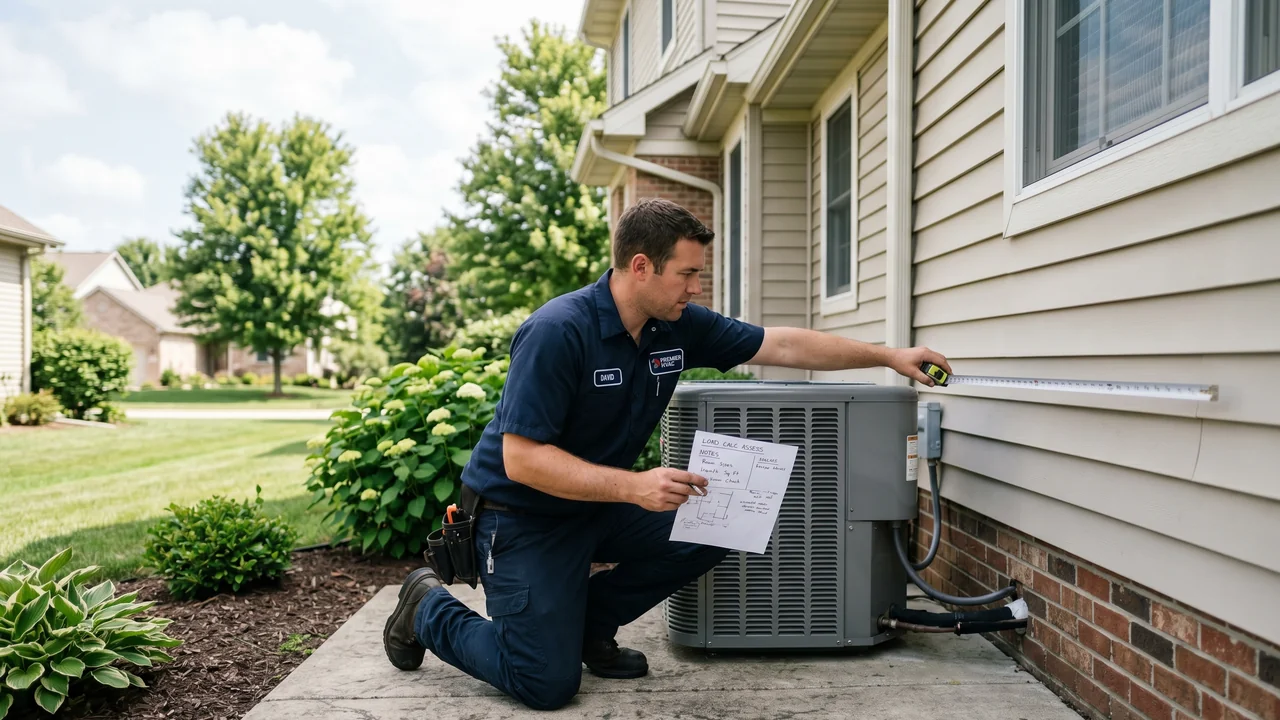
1. "Can you share the Manual J load calculation?" A reputable contractor produces it before quoting equipment and is willing to share. The document shows assumed inputs (square footage, ceiling height, R-values, window types, infiltration), the heating and cooling loads by zone and total, and the recommended equipment capacity. A contractor who quotes without one is using a rule of thumb; get a second quote.
2. "How does the recommended equipment tonnage match the Manual J load?" The math is direct: 12,000 BTU/hr equals 1 ton. A 36,000 BTU/hr design cooling load matches a 3-ton heat pump. If the Manual J shows 28,000 BTU/hr but the recommendation is 4-ton (48,000 BTU/hr), the equipment is oversized by 70% -- classic "round up for safety" error. Reputable contractors welcome the verification; the ones who don't are the ones to walk away from.
3. "Do the Manual J inputs match my actual home?" The most important sanity check. If the Manual J assumes R-19 attic insulation and you upgraded to R-30, the calc underestimates the home's thermal performance and oversizes the equipment. If it assumes single-pane windows and you have double-pane low-E, same issue. Walk through the input assumptions against your actual home, particularly any improvements made since build.
For cold-climate sizing (Zone 5+), the CCHP question matters too. Per the ENERGY STAR Cold Climate Heat Pump certification, a CCHP holds capacity at low outdoor temperatures and runs solo for more of the heating season. The right move in Zone 5+ is a CCHP correctly sized to the Manual J load; the wrong move is either an oversized standard unit or an undersized CCHP. The cold-weather physics explainer covers the balance-point math.
Climate Context: How Region Changes the Math
The same 1,800-square-foot home with identical insulation and occupancy has dramatically different design loads across markets. Approximate load ranges for that home:
- Eugene, OR (coastal, mild): Heating ~24-30k BTU/hr, cooling ~22-28k BTU/hr. A 2.5-ton standard heat pump fits. Rule-of-thumb pushes to 3.5-ton -- classic oversizing.
- Atlanta, GA (mixed-humid, cooling-dominant): Heating ~24-30k, cooling ~36-42k. A 3 to 3.5-ton unit matches the cooling-driven load. An oversized unit fails dehumidification, producing the "cool but clammy" complaint endemic to southeastern summers.
- Dallas, TX (mixed-humid, strongly cooling-dominant): Heating ~22-28k, cooling ~42-48k. A 3.5 to 4-ton unit. Long cooling seasons compound the dehumidification penalty of oversizing.
- Reno, NV (mountain, heating-dominant): Heating ~38-46k, cooling ~28-34k. A 4-ton CCHP-certified unit sized to the larger heating load. High elevation reduces refrigerant cycle efficiency slightly; a competent Manual J accounts for it.
Trusted Industry Sources
The sizing methodology, load-calc inputs, equipment-selection math, and verification framework in this article are consistent with published guidance from:
- ACCA — Technical Manuals (Manual J load calc + Manual S equipment selection)
- AHRI — Residential Equipment Certification (HSPF2 / SEER2)
- ENERGY STAR — Clean Heating and Cooling (Heat Pump certification + CCHP)
- U.S. Department of Energy — Heat Pump Systems
- EPA — Section 608 Technician Certification
A technician can run the load calc for your home and quote the right-sized heat pump -- with the Manual J PDF you can verify yourself.
Call Now — (844) 582-1795Disclosure: We are a referral service and may receive compensation for qualified calls. Calls may be routed to an independent provider network and may be recorded. Pricing and availability vary by provider and location.
Frequently Asked Questions
A heat pump is correctly sized through an ACCA Manual J residential load calculation, which computes the home's actual heat loss at winter design temperature and heat gain at summer design temperature based on specific inputs: conditioned floor area, ceiling height, wall and ceiling insulation R-values, window types and orientation, infiltration rate, occupancy, and internal heat loads from lighting and appliances. The output is a BTU-per-hour number for heating and cooling loads. Equipment is selected to match that load through the ACCA Manual S equipment selection procedure. The "one ton per 500 square feet" rule of thumb that many contractors use as a shortcut is wrong because it ignores every input except square footage.
Three specific failure modes. First, short-cycling: the unit reaches setpoint quickly, shuts off, then restarts moments later — cycle-count fatigue accelerates compressor and contactor wear. Second, failed humidity removal during cooling: an oversized unit's short run times produce cool but clammy indoor air, particularly in humid climates. Third, higher upfront and operating cost: a 4-ton unit costs $1,500-$3,000 more than a 3-ton to buy and install, without the larger capacity ever being useful.
An undersized unit cannot meet the home's heating or cooling load during the most demanding weather. For heating, the system runs continuously during cold snaps and leans on backup heat (resistance strips on all-electric installs, gas furnace on dual-fuel), which pushes operating cost toward resistance-heat economics. For cooling, the indoor temperature drifts upward during peak summer afternoons because BTU capacity is below the home's heat gain. Undersizing is less common than oversizing because contractors generally err on the larger side, but it happens when homeowners downsize equipment without re-running the load calc.
Yes, with three specific asks. First, request a copy of the Manual J load calculation that produced the recommended tonnage. A reputable contractor produces this before quoting equipment. Second, ask "what is the recommended equipment tonnage, and how does that match the Manual J heating and cooling load?" The math is direct: 12,000 BTU per ton, so a 36,000 BTU/hr design heating load matches a 3-ton heat pump. Third, sanity check the inputs against your actual home — if the Manual J assumes R-19 attic insulation and your home has R-30, the calculation is using bad inputs and the resulting size is suspect. Reputable contractors welcome verification questions.
Rarely, and only by coincidence. The rule approximates the Manual J answer for new-construction homes in moderate mixed-humid climates with average insulation. For homes outside those conditions — well-insulated newer or older leaky homes, hot-dry or cold climates, large window area, multistory layouts — the rule misses by half a ton or more. It persists in the contractor industry because Manual J takes 30-60 minutes to do correctly and the rule takes 10 seconds.
They interact at the balance point — the outdoor temperature at which the heat pump's heating capacity matches the home's heat-loss demand. A correctly-sized standard heat pump in a cold climate produces a high balance point and leans on backup heat for multiple winter months. A correctly-sized CCHP, engineered to hold capacity at 5°F outdoor, produces a lower balance point and runs solo for most of the heating season. The right move in Zone 5 and above is a CCHP correctly sized to your home's Manual J load. See our cold-weather heat-pump physics explainer for the balance-point math.
Local HVAC Service Areas
Cool Call Pro connects homeowners with independent HVAC technicians nationwide. Find a pro in Eugene (OR), Dallas (TX), Atlanta (GA), or Reno (NV), or browse by state: Oregon, Texas, or all locations.